The Role of Land Surveying in Successful Land Development Projects

Every successful land development project begins not with a shovel, but with a survey. Before any design can be drafted or a foundation laid, a precise understanding of the land itself is essential. Land surveying is the discipline that provides this critical data, serving as the foundational step for efficient, compliant, and ultimately profitable development. It is the process that defines boundaries, maps the terrain, and ensures a project starts on solid ground.
Mistakes made at this initial stage can have compounding effects, leading to costly redesigns, legal disputes, and significant project delays. At Terradyne, we deliver the precision and expertise required to navigate the complexities of your site.
Our comprehensive land development consulting services provide the certainty you need to move forward with confidence, transforming raw land into a valuable asset.
What Is Land Surveying in Land Development?
In the context of land development, surveying is a highly specialized science that involves measuring and mapping a property to determine its exact dimensions, features, and boundaries.
Using a combination of advanced technology, mathematical principles, and legal knowledge, professional surveyors create a detailed picture of a parcel of land. This information is indispensable for architects, engineers, and developers.
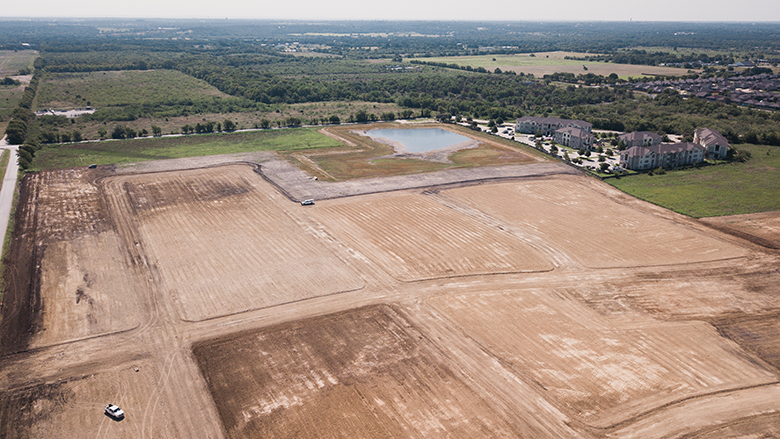
Failing to invest in a thorough survey is a significant risk. Imagine designing a residential community only to discover that a portion of the planned lots encroaches on a neighboring property or a protected environmental zone.
This oversight, easily preventable with an accurate boundary survey, can derail a project entirely. Professional surveying mitigates these risks by providing definitive data from the very beginning.
The Core Functions of Land Surveying
Land surveying is more than just measuring distances. It plays several critical roles throughout the development lifecycle, each contributing to a project's overall success.
Establishing Clear Property Boundaries
One of the most fundamental roles of a land surveyor is to locate and document the legal boundaries of a property. This process, known as a boundary survey, is crucial for preventing disputes with adjacent landowners and ensuring the project is built entirely within its legal limits.
Surveyors research historical records, deeds, and previous surveys before performing field measurements to mark the property corners physically. This legal verification is the only way to be certain of ownership lines.
Without it, a developer could inadvertently build structures on land they do not own, leading to expensive legal battles and potential demolition orders.
Mapping Topography & Site Features
Land is rarely a flat, empty canvas.

A topographic survey is essential for mapping the natural and man-made features of a site, including:
-
Elevations & Contours: Mapping the rise and fall of the terrain is critical for site grading, drainage design, and determining the optimal placement of buildings and infrastructure.
-
Existing Structures: Documenting the location of any buildings, fences, or other improvements.
-
Utilities: Locating underground and overhead utilities like water lines, sewer pipes, and electrical cables prevents costly and dangerous accidental damage during construction.
-
Natural Features: Identifying trees, bodies of water, and rock outcroppings allows planners to integrate them into the design or plan for their removal.
This detailed map provides the framework for all other design work. It enables civil engineers to design effective stormwater management systems and allows architects to position buildings to maximize views or minimize earthwork, directly impacting project costs and timelines.
Ensuring Regulatory Compliance
A complex web of local, state, and federal regulations governs land development. Land surveying is instrumental in ensuring a project complies with these rules.
This includes:
-
Zoning & Setbacks: Surveyors verify that the proposed site plan adheres to local zoning ordinances, including setback requirements that dictate how far structures must be from property lines, roads, and other features.
-
Easement Identification: An accurate survey identifies any legal easements on the property — such as a utility company's right to access a power line — that could restrict development.
-
Floodplain Delineation: If a property is near a river or other water source, an elevation certificate or floodplain survey determines which areas are at risk of flooding, a critical factor for obtaining permits and affordable flood insurance.
By identifying these constraints early, surveyors help developers avoid regulatory violations, fines, and forced work stoppages. This proactive approach is a hallmark of diligent and professional project management.
The Tangible Benefits of Accurate Surveying
Investing in professional land surveying delivers substantial returns by preventing errors, streamlining processes, and protecting your investment. The foundational work our team provides is integral to project success.
Preventing Costly Mistakes & Rework
The principle of "measure twice, cut once" is magnified exponentially in land development. An error in a survey can lead to a foundation being poured in the wrong location or a road being built at an incorrect grade.
Fixing such mistakes is exponentially more expensive than getting it right the first time. For example, discovering a boundary discrepancy after construction has begun could halt the project for months while legal issues are resolved, accumulating immense costs in delays and legal fees.
Precise surveying provides the reliable data needed to prevent these scenarios. It ensures that construction staking — the process of marking the exact locations of proposed improvements — is accurate, allowing contractors to build according to plan without issue.
Supporting Efficient Project Planning & Design
With a detailed and accurate survey in hand, the entire project team can work more efficiently.
Architects can create designs that are perfectly suited to the site's unique characteristics. Engineers can design infrastructure with confidence, knowing the exact topographical and boundary data.
This seamless integration of information reduces the need for time-consuming revisions and enables a more streamlined, cohesive planning phase.
Facilitating a Smooth Construction Process
The role of the surveyor does not end once construction begins. They are often called upon to perform construction staking, as-built surveys, and final surveys to ensure work proceeds as planned and to document the project's final state for regulatory approval.
This ongoing involvement helps keep the project on track and provides the verification needed to move from one construction phase to the next without delay.
Terradyne: Your Land Survey Partner for Unmatched Precision
A successful land development project is built on a foundation of certainty. Land surveying provides that certainty, offering the critical data needed to plan intelligently, design effectively, and build compliantly. It is an indispensable service that minimizes risk, saves money, and sets the stage for a profitable outcome.
With Terradyne, you gain a partner backed by 30 years of trusted ingenuity and solution-driven results. Our experienced land surveyors and ESAs use the latest technology to deliver precise, reliable data tailored to your project's specific needs. We understand that your timeline depends on accuracy and efficiency, and we are committed to providing the foundational work you need to succeed.
Contact Terradyne today to discuss your land surveying requirements and ensure your next project starts on the right footing.