Phase I vs. Phase II Environmental Site Assessments: What’s the Difference?
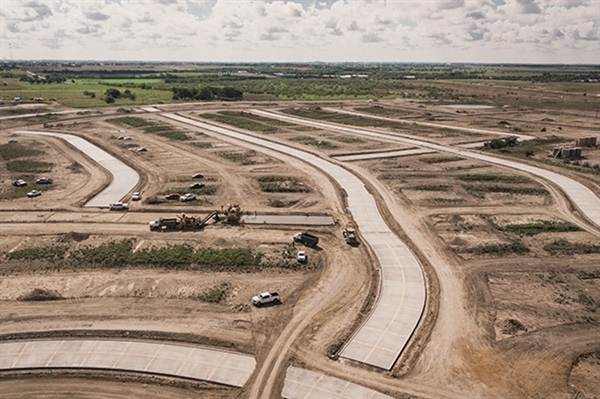
When purchasing or developing a property, understanding its environmental history is not just good practice; it is a critical component of due diligence. Environmental Site Assessments (ESAs) are the industry-standard tools used to evaluate a property for potential contamination and liability.
These assessments are typically conducted in phases, with Phase I and Phase II being the most common. While they work together, they serve distinct purposes.
Understanding the differences between a Phase I and a Phase II ESA is essential for developers, investors, and lenders. One identifies potential risks, while the other confirms and quantifies them.
At Terradyne, our experts provide the expertise to navigate both phases, delivering the clear, actionable data you need to make informed decisions and protect your investment from unforeseen environmental liabilities.
Let’s walk through the key differences, so you are informed at every stage of the process.
Key Differences at a Glance: Phase I vs. Phase II ESA
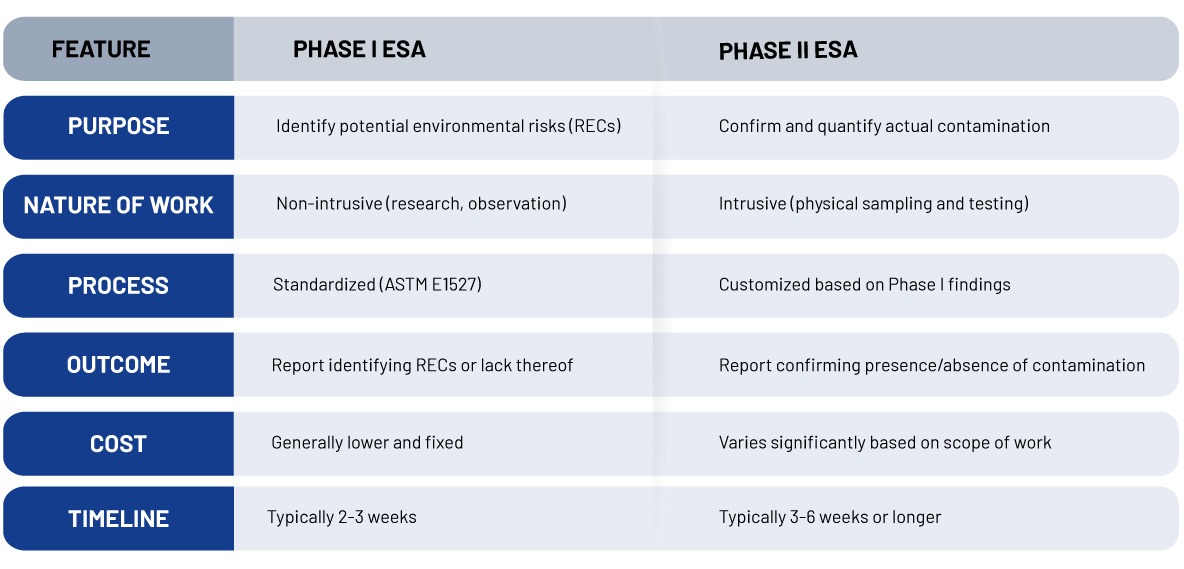
What Is a Phase I Environmental Site Assessment?
A Phase I ESA is a non-intrusive investigation designed to identify potential or existing environmental contamination liabilities at a property. Think of it as a background check on the land. The primary goal is to determine if there is a risk of contamination from past or present activities, either on the site itself or on neighboring properties.
This assessment does not involve any physical sampling or testing of soil, air, or water.
When Is a Phase I ESA Required?
A Phase I ESA is a standard requirement for nearly all commercial real estate transactions.
Lenders almost always mandate it to protect their investment from environmental liability. It is also a key step in satisfying the requirements for CERCLA (Superfund) liability protection for landowners. For developers, it provides the baseline environmental data needed to proceed with a project confidently.
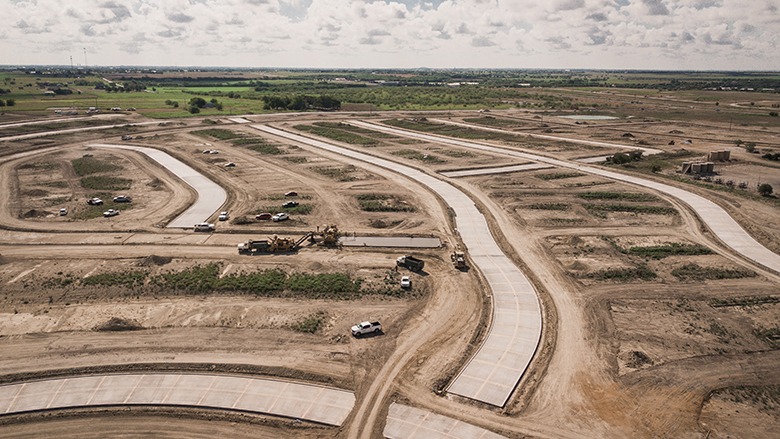
The Process of a Phase I ESA
The process is guided by the standards set by the American Society for Testing and Materials (ASTM E1527).
- A typical Phase I ESA includes four main components: records review, site reconnaissance, interviews, and report preparation.
1. Records Review
Our environmental professionals conduct an exhaustive search of historical records to understand the property's past uses. This includes reviewing aerial photographs, city directories, fire insurance maps, and federal, state, and local environmental databases.
The goal is to identify any evidence of activities involving hazardous substances, such as gas stations, dry cleaners, or manufacturing plants.
2. Site Reconnaissance
A thorough physical inspection of the property is performed to observe current conditions. The assessor looks for visual evidence of potential contamination, such as stained soil, strange odors, storage drums, stressed vegetation, or monitoring wells.
The inspection also covers adjacent properties to identify any off-site threats.
3. Interviews
We interview current and past owners, operators, and occupants of the property, as well as local government officials. These conversations can reveal crucial information about historical property use and incidents (like spills) that may not appear in official records.
4. Report Preparation
All findings are compiled into a comprehensive report. The report summarizes the research and identifies any Recognized Environmental Conditions (RECs), which are defined as the presence or likely presence of hazardous substances or petroleum products indicating a release, a past release, or a material threat of a release into the environment.
What Is a Phase II Environmental Site Assessment?
If the Phase I ESA identifies a Recognized Environmental Condition (REC), a Phase II ESA may be recommended.
The purpose of a Phase II ESA is to confirm whether the potential contamination identified in Phase I actually exists. This phase is an intrusive investigation that involves collecting and analyzing physical samples.
When Is a Phase II ESA Required?
A Phase II ESA is not always necessary. It is performed only when the Phase I ESA uncovers credible evidence of potential contamination warranting further investigation.
The decision to proceed with a Phase II is typically made by the client in consultation with environmental professionals, often at the request of a lender or a prospective buyer who needs certainty about the property’s environmental condition.
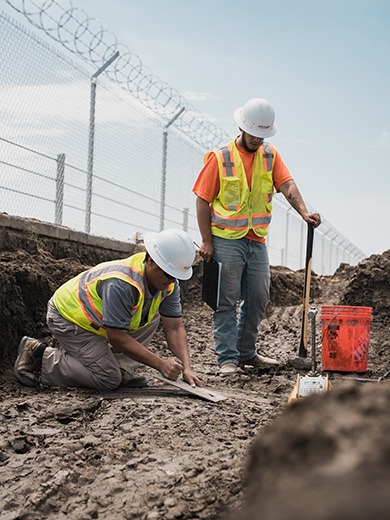
The Process of a Phase II ESA
Unlike the standardized Phase I process, a Phase II ESA is tailored specifically to the findings of the Phase I report. The scope of work is designed to target the specific RECs identified.
Work Plan Development
Based on the Phase I findings, our team develops a sampling and analysis plan. This outlines the media to be tested (soil, groundwater, soil vapor), the locations where samples will be collected, and the specific contaminants to be analyzed.
Field Sampling
Certified technicians are deployed to the site to collect samples using specialized equipment like drill rigs and hand augers. For example, if a former underground storage tank was identified as a REC, soil and groundwater samples would be collected from the area around the former tank.
Laboratory Analysis
The collected samples are sent to an accredited laboratory for chemical analysis. The lab tests for the presence and concentration of specific contaminants, such as petroleum hydrocarbons, volatile organic compounds (VOCs), or heavy metals.
Data Evaluation + Reporting
Laboratory results are compared with applicable state and federal regulatory standards. A detailed report is then prepared that summarizes the findings, confirms whether contamination is present, and describes the extent and concentration of any hazardous substances identified.
Trust Terradyne to Help You Build On a Foundation of Certainty
Navigating the complexities of environmental due diligence is essential for mitigating risk in any land development project. Phase I and Phase II ESAs are the tools that provide the necessary insight to protect your investment and ensure regulatory compliance. Whether you are identifying potential issues or confirming their existence, a thorough assessment is non-negotiable.
With Terradyne, you work with experts backed by nearly 30 years of trusted ingenuity and solution-driven results. Our team of environmental professionals provides comprehensive Phase I and Phase II ESA services, delivering the precise data you need to make critical decisions with confidence.
Contact Terradyne today to discuss your environmental assessment needs and ensure your project is built on solid, clean ground.